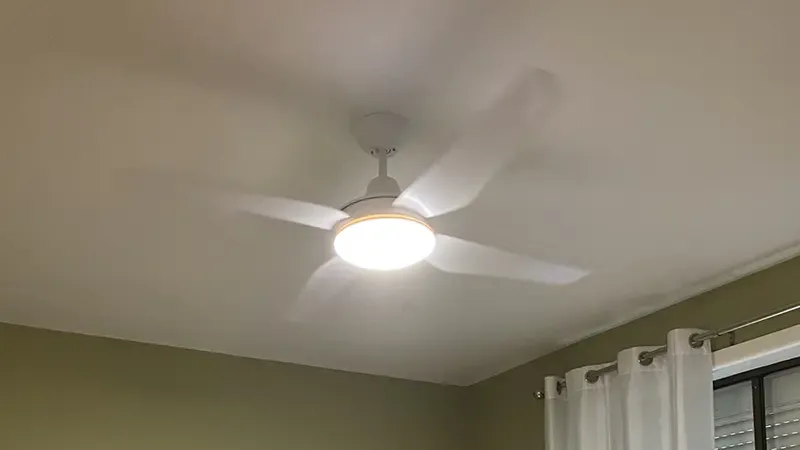
In the AC vs DC ceiling fan decision, DC is the better pick for any new or replacement fan in a Revesby home, though a working AC fan is still worth keeping. Hunter Pacific's datasheets show its 132 cm DC model drawing 34.8 W at top speed against 62 W for the matched AC model. CHOICE testing puts average running costs at about $17 a year versus $25.
Powerhub Electrical Revesby installs ceiling fans for homes across Revesby and the wider Bankstown area. Bankstown Airport's weather records, covered further down, show why fan efficiency counts in local summers. This guide covers running costs, controls and wiring, and NSW installation rules.
AC vs DC Ceiling Fans Explained
Why does one ceiling fan come with a speed dial on the wall while another arrives with a remote in the box? The answer sits inside the motor housing:
AC Ceiling Fan Motors
An AC ceiling fan runs its motor directly on the household's alternating current. Hunter Pacific's Concept AC datasheet lists a 16-pole AC motor with a 3-speed wall control that uses 3.5 μF and 2 μF capacitors. Those capacitor values are listed for that specific fan, so its wall control is matched to the model rather than being a generic switch.
DC Ceiling Fan Motors
CHOICE's buying guide explains that DC fans carry an internal rectifier, so they work on a normal AC electrical system. The same guide notes DC motors are now the most common type of ceiling fan, with up to seven speed settings against three on AC models.
Speed control usually moves to a handheld remote, like the 6-speed remote listed on the Concept DC datasheet.
Wiring and licensing rules matter as much as the motor. The Concept DC installation manual requires an isolation switch for that fan and bans solid-state wall controllers. Meanwhile the NSW Government treats installing or replacing any ceiling fan as licensed work finished with a CCEW, and Energy NSW wants a ceiling box rated for the fan's weight and vibration.
DC Ceiling Fan Running Costs in Revesby
Energy NSW describes DC motor fans as quieter and 70% more efficient than AC models, and says a fan can run for as little as 1 to 3 cents an hour. Treat that 70% as a best case, because one matched pair tells a more modest story.
The Concept AC datasheet lists Hunter Pacific's 132 cm AC fan at 62 W on high, moving 14,096 cubic metres of air an hour. Its twin on the Concept DC datasheet draws 34.8 W for 14,198 cubic metres, which works out to about 44% less power at top speed. At a matched mid-range breeze of roughly 6,990 cubic metres an hour, the figures are 26 W against 12.6 W, or about 52% less.
CHOICE testing turns those watts into dollars: AC fans average $25 a year and DC fans $17, based on 8 hours a day for six months at 40c per kWh. That's a real saving, but a small one. CHOICE's own advice is not to get rid of an old fan just to save a couple of dollars a year.
The Bureau of Meteorology records an average of about 42 days a year at 30 °C or more at Bankstown Airport. Hot days mean longer fan runs, and every one of those hours runs at the lower DC draw.
For a new ceiling fan installation, DC is the efficient default, whereas a healthy AC fan earns too little from a swap to justify one on running costs alone.
DC Ceiling Fan Wall Controls and Wiring
Swap an AC fan for a remote-only DC model and the rotary speed dial on your wall has nothing left to control. Three wiring points decide what goes there instead:
- Isolation switch, no dimmers: The Concept DC installation manual requires an isolation switch in series with the fan's supply to comply with AS/NZS 60335.1, supplied with its wall plate by the installing electrician. It also bans solid-state wall controllers, since neither leading-edge nor lagging-edge types run the fan satisfactorily, and allows only controls Hunter Pacific has approved.
- Paired DC wall controller: A DC wall controller pairs with the fan's receiver, and the Concept DC manual caps one controller at two fans, each with its own receiver, in the same room. With one fitted, the Concept DC is limited to 6 speeds and 6 dimming settings. Pairing starts with the power off at the isolation switch for 30 seconds, then back on.
- Hard-wired DC models: Not every DC fan is remote-only. Hunter Pacific's Ayer DC datasheet describes a hard-wired 3-speed wall control model that needs one switch wire for the fan and another for the light.
Each option changes the wiring behind the wall plate, so the choice is best made before the old fan comes down. If you'd also like app or voice control, plan the smart home wiring in the same visit.
AC vs DC Ceiling Fan Comparison Table
Need the short version before you buy? This table lines up the key AC vs DC ceiling fan differences side by side, using one matched pair wherever wattage matters:
| Feature | AC fan | DC fan |
|---|---|---|
| Speed settings | 3 | Up to 7 (6 on the Concept DC) |
| Power at top speed (132 cm Concept pair) | 62 W | 34.8 W |
| Average yearly running cost | About $25 | About $17 |
| Usual control | 3-speed capacitor wall control | Handheld remote or paired DC wall controller |
| Solid-state wall controllers | Not allowed | Not allowed |
Figures come from CHOICE testing and Hunter Pacific's Concept datasheets and installation manuals. The power row looks dramatic, yet the running-cost row brings it back to earth at about $8 a year. Give the two control rows equal attention, because they decide what ends up on your wall and how the fan is wired.
Installing a DC Ceiling Fan in Revesby Homes
A fan swap on an existing ceiling point looks like a quick weekend job for a handy owner. The NSW Government lists "install or replace ceiling fans" among tasks only a qualified electrician should attempt, and the electrician must issue a uniquely numbered Certificate of Compliance Electrical Work (CCEW).
Energy NSW adds two physical requirements: a ceiling box rated for the fan's weight and vibration, and installation at a safe ceiling height.
Hunter Pacific's installation manual fills in the detail for the Concept DC: blades at least 2.1 m above the floor and a bracket screwed to solid timber framing, steel or concrete. Any added bracing must be fixed to the rafters, not left floating on the ceiling. Fan, light and bracket must all be earthed, with fan and light on the same final circuit, and on-site warranty claims are refused if an unlicensed person did the installation.
Fans with a built-in light add a second load to wire and switch, so they're best planned alongside any lighting installation in the same room. Our licensed team gives a fixed, obligation-free quote before any work goes ahead.
Choosing Between AC and DC Ceiling Fans in Revesby
Nobody wants to pay for a fan swap that saves almost nothing, or to lose the wall dial they reach for every night. Match the motor to your situation:
- Buying new or replacing a dead fan: Go DC. The lower draw and wider speed range both come with a purchase you were making anyway.
- Your AC fan still runs well: Keep it until it fails, since the running-cost saving on its own is small and the old fan still does its job.
- You want a wall dial and no remote: Stay with AC, or choose a hard-wired DC model that comes with its own wall control.
- Your fan hums, wobbles or has stopped: Book electrical fault finding before buying anything, because a fault in the existing wiring stays put when the fan changes.
Skip that last check and a brand-new DC fan inherits the old problem.
Conclusion
For any fan bought now, a DC motor wins on efficiency. The matched Hunter Pacific pair moved the same air on far less power. Still, CHOICE's testing puts the yearly difference at only a few dollars, so a healthy AC fan can stay where it is.
Controls are the bigger practical change. Where an AC fan relies on a capacitor speed dial, most DC fans take orders from a remote or a paired DC wall controller, and some use a hard-wired wall control. Hunter Pacific also requires an isolation switch for its Concept DC and rules out solid-state dimmers.
Whichever motor you choose, NSW treats fitting or replacing it as licensed work. Expect a fan-rated ceiling box, blades at a safe height and a CCEW at the end.
Areas We Service
Ceiling fan installations, replacements and wall control upgrades are carried out for homes in Revesby, Revesby Heights, Padstow, Panania, Picnic Point, East Hills and Milperra. Whether it's a single bedroom fan or a house full of them, licensed electricians handle the work and finish it with a CCEW.
Book a Ceiling Fan Installation in Revesby
The right motor and controls depend on your actual ceiling and wiring, so get them checked before you buy. Call Powerhub Electrical Revesby on 0400 332 331 and ask about the current offers on your booking:
- $50 off your first service (new customers)
- 15% pensioner discount
- Free 5-star electrical safety inspection with every booking
- Fixed, obligation-free quotes before work starts
- Electrical Supervisor Licence #467291C
Frequently Asked Questions About AC vs DC Ceiling Fans
These short answers cover common questions about AC and DC ceiling fans, from running costs and wall switches to licensing and NSW loans:
What is a DC ceiling fan?
A DC ceiling fan uses a direct current motor fed through an internal rectifier, so it runs on household power. It offers more speed settings than an AC fan and usually comes with a remote.
Is a DC ceiling fan cheaper to run than an AC fan?
Yes, though the saving is modest. CHOICE testing found DC fans average about $17 a year to run against $25 for AC fans, based on 8 hours a day for six months.
Can a DC ceiling fan work with a wall switch?
Yes, through a paired DC wall controller or a hard-wired DC model with its own wall control. Hunter Pacific also requires an isolation switch and bans solid-state, dimmer-style controllers.
How can I tell if my ceiling fan is AC or DC?
Start with the controls. An AC fan usually has a 3-speed capacitor dial on the wall, while a DC fan usually runs from a remote. Hard-wired DC models exist, so check the model label too.
Do I need an electrician to install a DC ceiling fan in NSW?
Yes. The NSW Government lists installing or replacing ceiling fans as work only a qualified electrician should do, and the electrician must give you a uniquely numbered CCEW afterwards.
Can I get a NSW loan for a new ceiling fan?
NSW Home Energy Saver loans cover an AC or DC ceiling fan installed at a safe height by a licensed electrician lodging a CCEW. Loans were open in October 2026, while discounts were not yet.