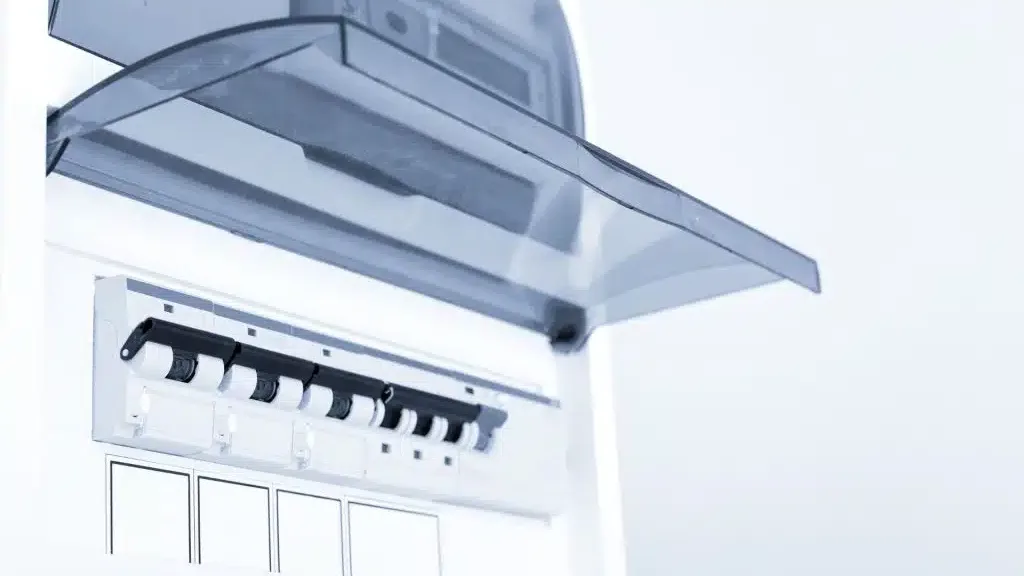
RCD testing checks that a safety switch (RCD) still cuts the power when it should, and it takes two forms. Pressing the test button only proves the switch trips, while an electrician's instrument test confirms a standard 30 mA switch trips within 300 milliseconds and at the right leakage current. For the home button test, NSW Government pages say every six months or every three, so pressing it every three months covers both.
Powerhub Electrical Revesby works on safety switches in homes, rentals and small businesses around Revesby, a suburb where more than a third of occupied homes are rented, according to ABS Census data. This guide covers the push-button test, the electrician's trip-time test, and what NSW rules require of landlords and workplaces.
RCD Testing Basics for Revesby Homes
A 30 mA safety switch has under a third of a second to act. NHP's earth leakage guide gives 300 milliseconds under AS/NZS 61008 and 61009, tripping at 50% to 100% of rated current.
In plain terms, an RCD cuts the supply once it senses current escaping to earth. SafeWork NSW's code of practice on electrical risks classes a switch rated above 10 and up to 30 milliamps, tripping within 300 milliseconds, as a Type II RCD suited to personal protection. It also flags a blind spot: a person touching both active and neutral won't cause a trip unless some current flows to earth as well.
Think of a safety switch as a last line of defence, then, and one that only helps if it still trips on time when a fault happens. Two tests check that: a button press anyone can manage at home, and a licensed electrician's tester that shows how fast it trips.
Who must test also depends on the property. NSW workplaces must have RCDs tested regularly by a competent person under the WHS Regulation 2025, while NSW rental guidance treats a faulty safety switch as an urgent repair.
The Push-Button RCD Test at Home
No tools are needed for the home check, and the NSW Government advises testing each safety switch twice a year, working through these steps in order:
- Warn the household. Let everyone know the power is about to drop, and switch appliances off at the power point first.
- Press the test button. It's marked 'T' or 'Test', and the switch should flip to the off position without any undue delay.
- Check the circuit is dead. Lights, appliances and power points on that circuit should have no power at all while the switch is off.
- Reset the switch. Flip it back on to restore power. If it didn't trip, or it won't reset, a licensed electrician needs to replace it.
The official advice splits on timing, though. NSW Fair Trading says to push the test button every three months, then suggests daylight saving changes as the reminder, even though the clocks only change twice a year. Two government sources, two different answers.
So which interval should you follow? With one NSW Government page saying six months and another saying three, the shorter interval is the safer habit, and it satisfies both. A reminder at the start of each season keeps the job on track without much thought.
What the button can't tell you is how quickly the switch cut the power, and that's where the electrician's test comes in.
Instrument RCD Testing by a Licensed Electrician
Can a safety switch pass the button test and still be too slow? It can, because the button proves the switch moves, not how quickly it cuts the power or at what leakage.
An instrument test answers both questions by putting a measured leakage current through the switch and timing the trip against the 300 millisecond limit and the 50% to 100% trip range. NHP's guidance adds that loads should be disconnected before testing, because connected appliances affect the result.
On construction sites, NSW spells out both tests. SafeWork NSW's fact sheet sets fixed RCDs at a monthly push-button test and a 12-monthly operating-time test, with portable units tested by button before each use and timed every 3 months. Those intervals come from AS/NZS 3012:2019, which section 163 of the WHS Regulation 2025 makes mandatory.
If a switch fails either test, the safety switch installation service covers testing and replacement for homes, rentals and small businesses. When a switch passes but keeps cutting out during normal use, electrical fault finding traces the trip back to the appliance, damaged cable or moisture behind it.
RCD Testing Rules for Revesby Rentals
A tenant moves into a Revesby rental, and nobody can say when the safety switch was last tested, or whether it still trips at all when it matters.
Rentals make up a big slice of local housing. ABS QuickStats for 2021 show 35.9% of Revesby's occupied private dwellings were rented (1,790 homes), compared with 32.6% across NSW.
The NSW Government's rental safety guidance reminds agents and landlords that testing the safety switch is the only way to confirm it works at the start of a tenancy. A faulty switch, or one detecting an electrical fault before or during the tenancy, counts as an urgent repair under the same guidance.
NSW home safety advice says tenants can ask the agent or landlord whether there are safety switches, where they are located and for permission to test them. Spotting one is simple, because each has a test button with a label such as 30 mA. For switches on common property, strata owners ask the strata manager to include them in the scheme's regular safety checks.
Skip the button test at handover, and a dead switch can sit unnoticed through an entire lease.
RCD Testing Requirements for NSW Workplaces
Workplaces in NSW must have RCDs tested regularly by a competent person, yet no interval is set. NSW Legislation shows this in the Work Health and Safety Regulation 2025, which replaced the 2017 Regulation.
Under section 165, records of every test other than daily checks must be kept until the RCD is next tested or permanently removed from use. Section 164 then requires an RCD, so far as is reasonably practicable, on socket outlets supplying equipment that's frequently moved or exposed to moisture, heat, vibration, mechanical damage, corrosive chemicals or dust. On outlets up to 20 amps, the same Regulation caps the tripping current at 30 milliamps.
For a Revesby shopfront, café or trade workshop, the duty to take all reasonable steps comes down to three habits. Set a testing schedule, use a competent person, and keep a record of each test. Building and demolition sites add the fixed construction intervals set out earlier in this guide.
Homes work differently, because the household button-test timing comes from NSW Government advice rather than the WHS Regulation, which covers workplaces. In both settings, though, a failed test calls for the same response.
When a Safety Switch Fails Its RCD Test
A failed test has one next step, and it isn't resetting and hoping. SafeWork NSW's code of practice says a faulty RCD must be taken out of service and replaced as soon as possible.
Until then, treat every circuit on that switch as unprotected. Replacement is licensed electrical work, and NSW home safety advice says you should receive a uniquely numbered Certificate of Compliance Electrical Work (CCEW) from the electrician. For homes built before 2000, the same page strongly recommends asking a licensed electrician to check.
If the failed switch sits on an older board, ask about a switchboard upgrade at the same visit, so both jobs are planned together rather than one after the other. Our licensed team quotes a fixed, obligation-free price before any work starts, so the cost of each option is clear upfront.
Conclusion
RCD testing comes down to two questions: whether the switch trips, and whether it trips fast enough at the right leakage. The test button answers only the first, while an electrician's instrument test measures trip time and trip current against the limits set for the device.
At home, NSW Government advice is split between six-monthly and three-monthly button tests, and a quarterly press satisfies both. Rentals and workplaces carry extra duties.
Workplaces must have RCDs tested regularly by a competent person and keep the records. Landlords should test at the start of each tenancy and treat a faulty switch as an urgent repair. Any switch that fails comes out of service and gets replaced promptly by a licensed electrician.
Areas We Service
Safety switch testing and replacement are available for homes, rentals and small businesses across the Canterbury-Bankstown area. That covers Revesby, Revesby Heights, Padstow, Condell Park, Georges Hall, Bass Hill and Yagoona, plus the streets in between. Help is on hand whether you need a check after a failed button test or a new switch.
Book Safety Switch Testing in Revesby
A safety switch that fails its test, or hasn't been checked in years, is protection you can't count on. Call Powerhub Electrical Revesby on 0400 332 331 to book safety switch testing or a replacement, and mention the current offers:
- $50 off your first service (new customers)
- 15% pensioner discount
- Free 5-star electrical safety inspection with every booking
- Fixed, obligation-free quotes before work starts
- Electrical Supervisor Licence #467291C
Frequently Asked Questions About RCD Testing
Quick answers on RCD testing for Revesby homeowners, landlords and business owners, from the home button test to the rules NSW sets:
What is RCD testing?
RCD testing checks that a safety switch cuts the power when current leaks to earth. You can press the test button at home, while an electrician's instrument test measures trip time and trip current.
How often should I test my safety switch in NSW?
Every three months is the safest choice. NSW Government pages give two intervals, some saying every six months and others every three, so a three-monthly test satisfies both sets of advice.
Is pressing the test button enough?
Not for a full check. The button proves the switch trips, but only an electrician's instrument test shows whether a 30 mA switch cuts the power within 300 milliseconds at the right leakage.
Is RCD testing a legal requirement in NSW?
Yes, for workplaces. The WHS Regulation 2025 requires regular RCD testing by a competent person, with records kept. For homes, NSW Government advice sets the timing: press the button every three to six months.
Do NSW landlords have to test safety switches?
Landlords should test at the start of each tenancy, as NSW Government guidance calls testing the only way to confirm it works. A faulty switch, or one detecting a fault, is an urgent repair.
What happens if my safety switch fails the test?
It must come out of service and be replaced as soon as possible by a licensed electrician, who issues a compliance certificate. Replacements must be Type A or Type B RCDs under NSW rules.